Understanding Your Lactate Threshold (LTHR)
Most people have heard of the "220 minus your age" formula for estimating max heart rate, but that method is outdated and inaccurate. Your real training intensity is far better guided by a more reliable metric: Your Lactate Threshold Heart Rate (LTHR).
Your LTHR is the highest heart rate you can sustain for a strong, steady effort over a prolonged period.

Knowing this number helps you take control of your training and results.
Train at the right intensities
Avoid overtraining
Improve fitness safely and efficiently
Monitor your progress over time
It is a much more accurate and meaningful metric than estimating your maximal heart rate.
How to Perform the LTHR Test (Simple Version)
1. Warm Up (10–15 Minutes)
Do a light jog followed by dynamic movements to prepare your body for the test.
Knee lifts
Heel flicks
Side steps
Lunges
Skipping works really well- both feet, then hopping from one foot to the other if you can (practice)
2. The 30-Minute Test
This test is designed for anyone who can run continuously for 20–30 minutes.
Action
Start your heart rate monitoring watch
I’m going to keep this simple- if you don’t have a smart watch, go invest in one
Reccomendations include Garmin, Apple, Suunto — I use the Garmin Forerunner 265, which I really like, but I’ve had all 3 at one point and all are great.
Run at a pace you can sustain for the full 30 minutes. This should feel like a strong, steady effort.
After the first 10 minutes, press the LAP button on your watch.
Finish the remaining 20 minutes of the 30-minute run.
Calculation: Your average heart rate from minutes 10–30 is your LTHR.
If You Cannot Run 20–30 Minutes Continuously
If you are not yet fit enough to complete the full 30-minute test safely, start with this simple run/walk build-up:
Run 2–3 minutes
Walk 1–2 minutes
Repeat 5–6 times
As your fitness improves, you will be able to complete the full LTHR test safely and accurately.
Using Your LTHR
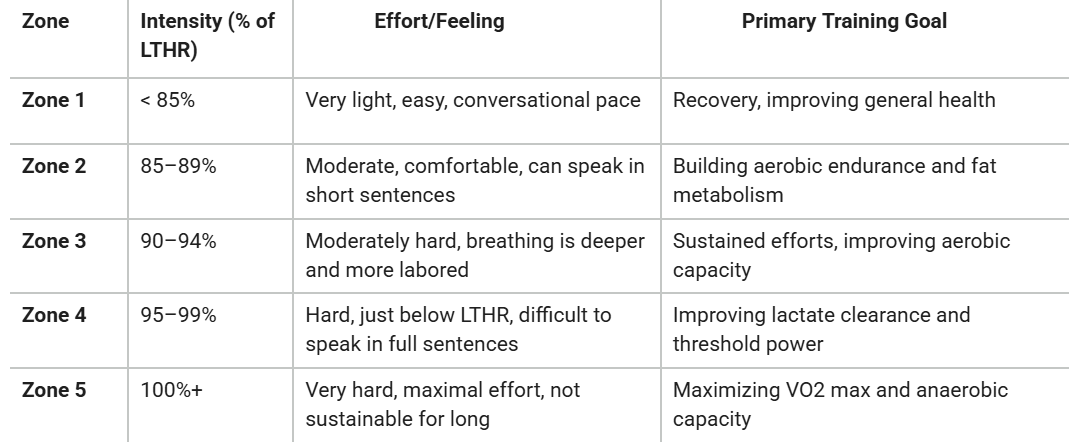
Once you know your LTHR, you can tailor your training intensity more effectively.Training Zones Based on LTHR
Using your LTHR to define heart rate training zones allows for precise control over your effort, ensuring you target specific physiological adaptations. These zones are defined by a percentage of your LTHR and correspond to different training goals.
Training Zones
Important Note
This guide is for general educational use. If you are unwell, returning from injury, or unsure about your ability to run continuously, please avoid performing maximal effort tests. Consult with a medical professional before starting any new exercise regimen.